I stopped letting AI write under my name

I went deep on automating content pipelines. At one point, I experimented with automating the content itself. I trained the system on “my voice,” read what it produced, and kept finding the same problem: I wasn’t personally satisfied with what it had written.
That was an uncomfortable result. I was building a pipeline to help me make content, and the part I most wanted to keep was the part I’d handed over.
When automation went too far
I wanted to see how much of content production I could automate. If an agent could learn how I wrote and produce a finished piece, I could spend more of my time on everything around the writing.
So I tried it. I kept working on the voice training, but the finished content still didn’t pass my own test. It could sound like something I might have written without feeling like something I had chosen to say.
What was missing was judgement about what the piece was for. In one week, for instance, the system I had designed gave me four candidate posts. I approved two full drafts in “my voice,” but before publishing I ended up rewriting nearly 60% of the original content before they went out. Each one technically sounded like me, but was stilted, too conventional, and sometimes, didn’t really focus in on exactly what the point of the post was supposed to be.
That distinction matters if you publish under your own name. A familiar turn of phrase doesn’t tell you whether you believe the argument, whether you’d defend an example, or whether you’ve said the thing you meant to say. I can’t outsource those decisions and then call the result my voice because it resembles my previous work.
I’m not arguing that agents can’t write useful content. I’m describing where the experiment failed for me. Once I knew I didn’t want the finished prose, the question changed: what could the agent give me that would make my writing better?
A different division of labor
Now I use my agentic framework to prepare a content brief. It gives me context before I sit down to write, and it leaves me room to decide what I think. I write the content by hand. Afterward, I use a scoring engine based on my own analytics continuously refreshed to evaluate what I’ve written.
The agent helps with preparation and feedback; I’m the author of the sentences and the argument.
If you make technical content, you probably know the temptation to skip straight to a draft. You have a topic, some notes, and a publishing deadline. An agent can turn those inputs into paragraphs quickly. But speed at that stage can leave you editing a position you never chose. You’re reacting to someone else’s first pass instead of working out your own.
A brief is a different kind of help. I read the context, decide what belongs, and discard the rest before I begin writing anything. I still have to do the work of writing, which is part of how I find out whether the idea holds together.
This is the boundary I arrived at after trying the other way. For my work, assistance is most useful when it makes my choices clearer rather than making them for me.
What goes in the brief
The brief’s job is to help me make editorial decisions. It should give me enough context to choose an angle, see what needs support, and notice what I still don’t know. It shouldn’t settle those choices by drafting the article in my voice.
My briefs give me an angle, reasons why it’s timely, sections with target focus points, specifics I can trace back to verifiable sources, and questions that require my personal input.
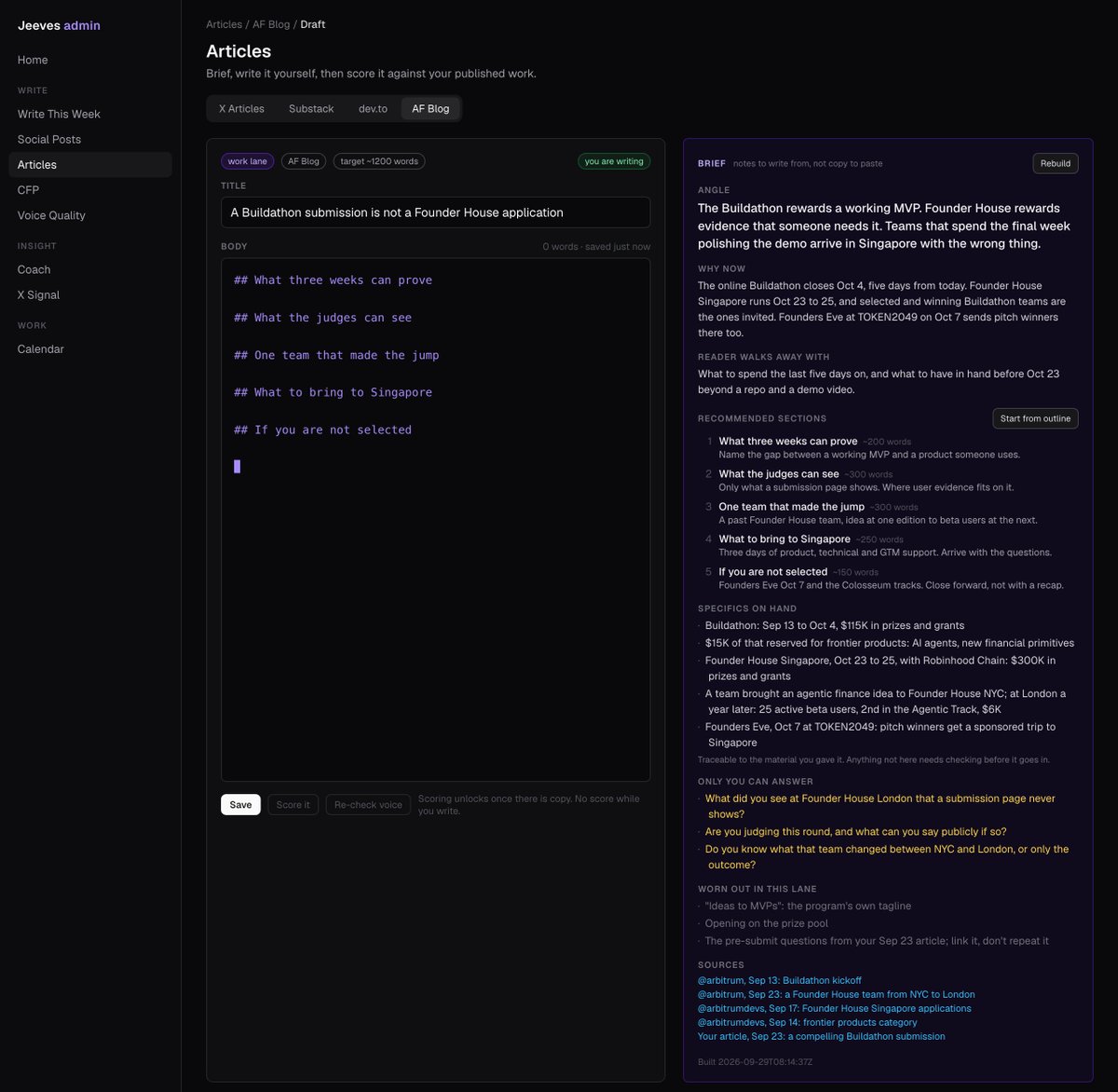 An example of my OpenClaw-powered brief generator.
That example matters more than a prompt recipe would. You can copy someone’s instructions to an agent and still end up with a piece that doesn’t sound like you, because the instructions aren’t where the authorship lives.
I want a brief to make the research phase more streamlined, and the questions for me to cover easier to discover, not answer them on my behalf. Sometimes the most helpful context will point toward a piece. Sometimes it will show me that I don’t have enough to write one yet.
Feedback without ghostwriting
After I write, I score the finished work against my own analytics. That gives me a way to look at how my content performs without asking an agent to produce the content for me.
The scoring engine has eight separate parts: format, hook, value, clarity, tone, call to action, fit and density. It’s calibrated against my own best-performing published posts, taken from a corpus of nearly 500 of my X posts that re-syncs twice a week. The calibration baseline itself refreshes monthly. It can give me good direction on whether a hook is weak or if a piece looks polished but is empty of value. It can never tell me if I stand behind the words in the post.
I’m careful about the authority I give that feedback. A score can prompt me to look again at a choice. It can’t decide whether I believe a claim or whether a sentence sounds like me. If I disagree with the assessment, I need to be able to say why and keep the sentence anyway.
That’s useful tension. Without feedback, I can mistake personal satisfaction for evidence that a piece connected with readers. Without editorial judgment, I can start writing toward whatever the numbers reward and lose the reason I wanted to write it. I need both views, but they do different jobs.
What changed, and what did not
Since finding this balance, I’ve seen stronger results on X. My impressions are up 130%, engagements up 100%, reposts up 300%, likes up 182%, profile visits up 60%, and follower count up 78%.
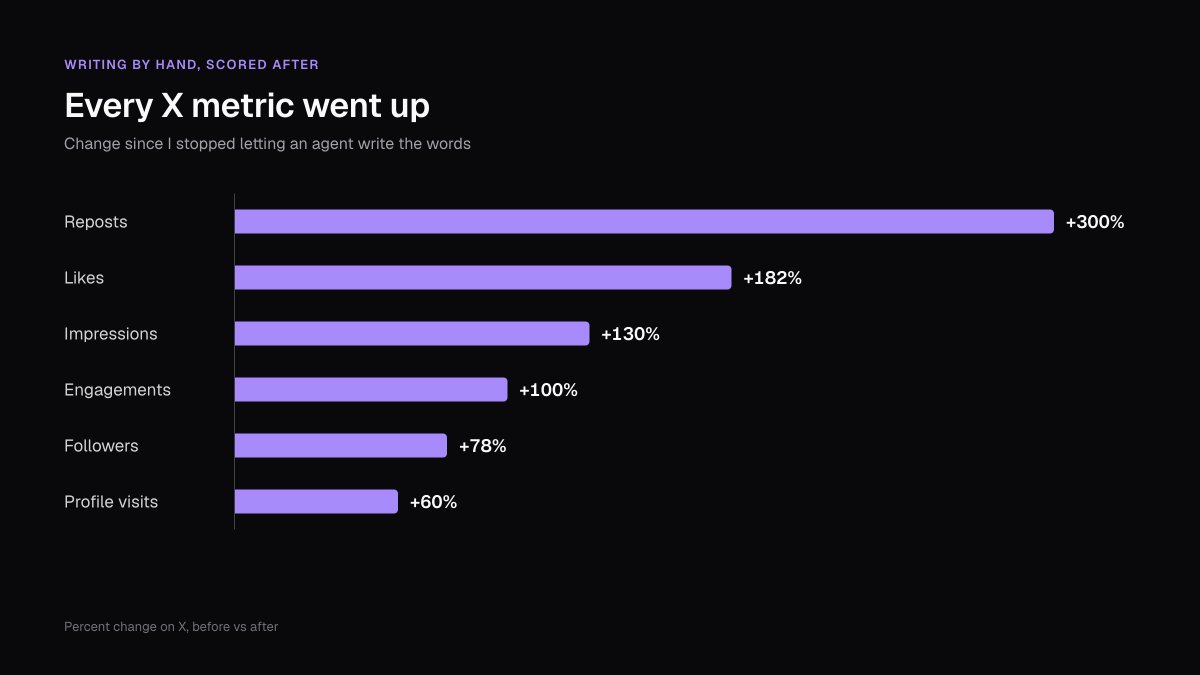 A chart displaying percentage changes in various engagement metrics.
That’s a pretty useful indicator that my readers are also pleased with my approach.
For me, the next piece still starts the same way: get the context, decide what I think, and write it myself. Then I’ll look at the feedback.
Maybe one day in the future, I can safely and comfortably delegate my voice to an agentic process, but after attempting in iterative approaches, I can confidently say, at least for me, that moment has not yet arrived.